Table of Contents
Here’s a pattern we have seen more often than we should.
A health plan, provider group, or ACO invests heavily in care management. The team is experienced, clinically strong, and deeply engaged with its members. Yet care gaps are still closing too slowly, costs are not moving in the right direction, or quality performance has stalled.
The first instinct is often to look at the people. Do we need more care managers? Better training? Different protocols?
In many cases, that is not where the real problem sits.
The care managers are doing their jobs. What is failing them is the infrastructure underneath the program: stale data, delayed clinical signals, fragmented member information, and workflows that do not route the right work at the right time.
Three case archetypes make that problem clear.
Case 1: Strong Care Managers, Outdated Gap Data
One health plan had a strong care management team with experienced clinicians, low turnover, good training, and solid member engagement.
But its HEDIS results were not improving as expected. Preventive care gaps, including screenings and annual wellness visits, were closing too slowly even when care managers had already discussed those services with members.
The problem was the data.
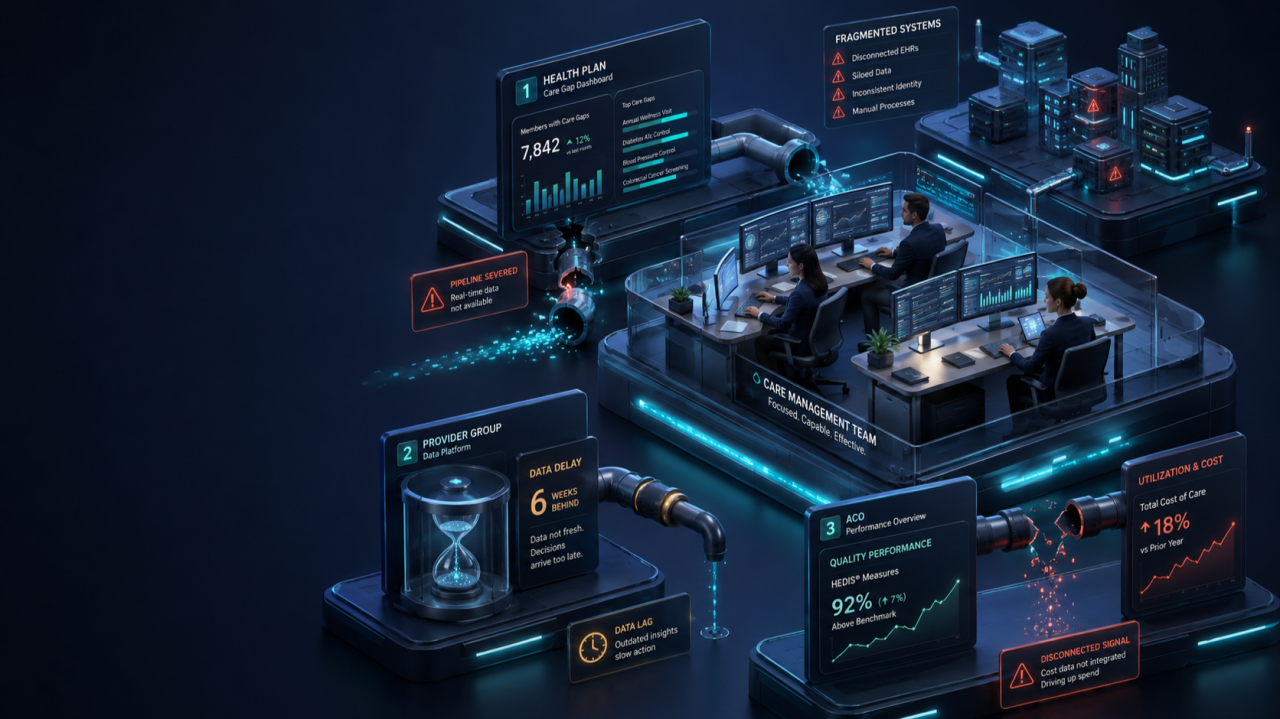
The team was working from gap lists refreshed monthly. By the time a care manager reviewed a member, the information could already be two to six weeks old. Members who had completed a service could still appear as having an open gap, while newly eligible members might not appear yet.
There was also no dependable feedback loop when a gap closed. Care managers could spend time following up on work that had already happened while other members who genuinely needed outreach were harder to identify.
The team was executing well. It was simply executing against outdated information.
What Changed
The organization moved toward more current claims and clinical data so gap status changes could reach the care management workflow sooner.
When a service was completed, the member record could update. When a new gap appeared, it could be surfaced with useful context such as member risk, engagement history, and upcoming appointments.
The team shifted from working static lists to focusing on members where intervention was still relevant.
The improvement did not come from asking care managers to work harder. It came from giving them better information to work with.
Case 2: A Mature Care Management Program Working Six Weeks Behind
A regional provider group had already invested significantly in care management. It had a dedicated team, established protocols, a care management platform, and regular case reviews.
Yet the organization was still struggling financially under its value-based contracts.
When the data flow was examined, one issue stood out: there was roughly a six-week delay between an important clinical event and that information becoming available to the care management team.
Claims processing delays, manual reconciliation across multiple EHRs, and batch-based data workflows meant care managers were often making current decisions using information from weeks earlier.
For complex patients, that delay matters.
A hospitalization, discharge, missed follow-up, or newly identified chronic condition becomes far less actionable if the care team learns about it long after the event.
The care managers were not overlooking these members. The information was simply reaching them too late.
What Changed
The data pipeline was redesigned to reduce that lag.
ADT feeds were connected more directly, claims visibility improved, and information across multiple EHR environments was reconciled into a more unified patient view.
Important events such as hospital admissions, discharges, missed follow-ups, and newly identified clinical concerns could then surface closer to when they occurred.
The care management team did not change.
What changed was its ability to intervene while the opportunity still existed.
Case 3: Strong Quality Performance, Rising Cost
The third case looked successful at first.
The ACO was performing well on HEDIS measures. Its care management team was actively working on preventive services, screenings, medication adherence, and other quality priorities.
But total cost of care was increasing and shared savings performance was deteriorating.
The problem was that quality and utilization were operating in separate workflows.
Care managers could see care gaps, but they had limited visibility into utilization signals such as repeated emergency department visits, inpatient admissions, high-cost imaging, and specialist activity.
A member could therefore look manageable through the quality lens while their recent utilization was telling a very different story.
Quality work was happening in one lane. Cost was moving in another.
What Changed
Utilization data was brought into the care management workflow alongside quality information.
Care managers could now see a broader member profile instead of viewing care gaps and utilization events separately.
A member with repeated ED visits, an unresolved diabetes gap, and no recent care management interaction could be prioritized differently from someone with the same quality gap but no sign of escalating utilization.
The team did not need a larger list.
It needed a better way to identify which members required attention first.
What These Three Cases Have in Common
The organizations were different, but the underlying problem was the same.
In each case, the care management team was capable. The failure point was how data moved into the program and how that information was translated into work.
One organization had stale care gap data. Another had a six-week information delay. The third had quality and utilization data operating separately.
All three situations created the same outcome: care managers were being asked to make good decisions without having the right information at the right time.
That is why adding staff alone often does not solve an underperforming care management program.
More care managers working from stale data still means stale decisions. Another dashboard does not help if the insight never reaches the workflow. More alerts do not help if teams cannot tell which members actually need attention.
The infrastructure has to support the people using it.
What Incuvio Does Differently
At Incuvio, we look upstream of the care manager.
That means looking at how quickly healthcare data moves, whether claims and clinical information are connected, how utilization and quality signals come together, and whether those signals can trigger action inside the care management workflow.
Depending on the organization, that can mean improving data pipelines, connecting ADT feeds, creating unified member views, reducing data latency, integrating utilization and quality information, or automating how priority work reaches the care team.
The goal is not to replace clinical judgment with technology.
It is to remove the data and workflow barriers that prevent care managers from using that judgment effectively.
Final Thought
When a care management program is struggling, it is easy to assume the team needs to do more.
Sometimes the better question is whether the system around them is doing enough.
The three cases above point to the same lesson: strong care managers cannot compensate indefinitely for stale data, delayed signals, disconnected information, and poorly routed work.
Fix the infrastructure, and the people who were already capable can finally work with the information and timing they need.

You may also like
 Articles
Why Healthcare Organizations Need a Fractional CTO
Healthcare organizations are being asked to make bigger technology decisions faster. Modernize […]
 Articles
The Hidden Cost of Starting Every Healthcare Data Warehouse From Scratch
A new healthcare data warehouse project often starts with a familiar promise: […]
 Articles
Why Pre-Built Data Models Matter in Healthcare Warehousing
Healthcare data warehouse projects often begin with a straightforward goal: bring data […]